Esther Greenwood
The Bell JarEsther Greenwood, the first-person narrator of The Bell Jar, is a gifted young woman whose outward prospects—college prizes, a fashion-magazine contest, and a month’s work in New York City—cannot protect her from a worsening sense of disconnection. Her crisis unfolds against the summer of the Rosenbergs’ execution and the pressure to choose a future that seems to require surrendering every other possibility. Through her perceptions, public success becomes a performance, ambition becomes a source of paralysis, and survival itself becomes an achievement that remains uncertain rather than triumphant.
Identity and Introduction
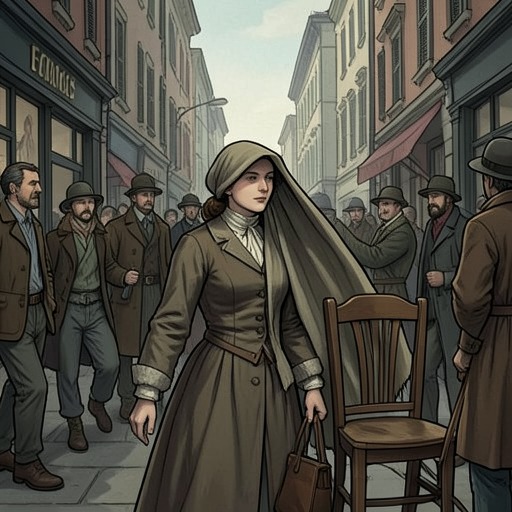
Esther arrives in New York City as one of twelve young women who have won a fashion magazine contest by writing essays, stories, poems, and fashion copy. Their prize is a month of paid expenses and work, accompanied by gifts and professional opportunities. From the outside, the arrangement looks like a dazzling beginning: the girls receive fashion-show passes, salon appointments, and introductions to successful people in the fields they hope to enter. Esther knows she is expected to feel lucky and excited, but cannot make herself respond as the occasion supposedly demands.
Her numbness is sharpened by the contrast between what the summer is meant to signify and what she actually experiences. She moves from hotel to work, parties, and back again, like a trolleybus following a fixed route rather than a young woman steering her own life. The surrounding commotion does not reach her; she feels still and empty at its center. The image makes her alienation less a rejection of opportunity than an inability to inhabit the role of the fortunate, ambitious girl that the opportunity has assigned her.
Public Success and Private Crisis
The execution of Julius and Ethel Rosenberg supplies the summer’s most persistent public image. Esther repeatedly encounters the news in newspaper headlines, on the radio, and at work. Although she insists to herself that the event has nothing to do with her, she cannot stop imagining what electrocution would feel like: being burned along the nerves. The news becomes an intrusive thought, returning in a manner she compares to the memory of a cadaver she had once seen. In that earlier memory, the cadaver’s damaged head keeps appearing beside breakfast and the face of Buddy Willard; now the Rosenbergs occupy the same unwanted territory of thought.
This public dread meets a private disappointment that Esther cannot easily name. She has bought expensive clothes that hang unused in her closet, and her college achievements seem to lose their value beyond the marble and glass of Madison Avenue. The polished setting does not confirm that her prizes have prepared her for a life; instead, it exposes the gap between what she has been rewarded for and what she can imagine doing next. Her unease is not visible in the magazine image of a glamorous young woman, which would show her in a silver-lamé bodice and white tulle among hired or loaned young men. That image promises a whirl of success, but Esther experiences herself as not steering anything—not even herself.
A retrospective account of the novel’s design places this divide within Esther’s return from the artificial pressures of the fashion-magazine world to the stagnant summer life of a Boston suburb. As those external pressures fall away, the cracks in her nature widen; domestic life and the neighbors around her appear through a view that is increasingly distorted yet feels to her like the only accurate one. The novel’s larger movement therefore makes her breakdown more than a private interruption to a successful career: the settings that are supposed to supply direction or normality instead expose how little either can hold her together.
Choice, Writing, and the Fig Tree
Esther’s anxiety about the future takes its most concentrated form in the fig-tree image. She sees her life branching into possible futures, each one embodied by a ripe fig: marriage and children, literary fame, academic distinction, becoming an editor, travel, lovers, or achievement as an Olympic rower. The abundance is attractive precisely because she wants every life available to her. But choosing one would mean losing the others, and she imagines herself stranded in the tree, unable to decide while the figs wrinkle, blacken, and fall.
The image turns opportunity into a trap without making any single future the villain. Esther is not short of ambitions; she is overwhelmed by their incompatibility and by the irreversible loss built into choice. Her earlier success at winning scholarships and prizes had given her a recognizable measure of progress, but she senses that this era is ending. She likens herself to a racehorse in a world without racetracks, or a champion whose glory has been reduced to a dated trophy. The old means of proving her promise cannot tell her what she wants to become.
Writing offers a more intimate, if precarious, form of self-recognition. On the breezeway, Esther imagines a heroine who resembles her but is disguised under another name: Elaine. She counts the letters in Elaine and Esther and finds six in each, taking the shared length as a lucky sign. The small act of naming allows her to make herself both the material of a story and an observer of it. Yet the scene does not establish that writing has cured her or settled her future; it shows a moment when she can turn her own experience into a form she can look at and shape.
Relationships, Treatment, and Self-Harm
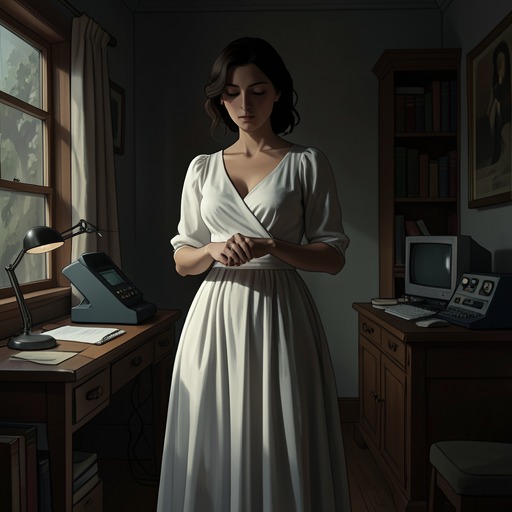
When she speaks with Doctor Gordon, Esther gives a deliberately flat account of not sleeping, not eating, and not reading. She does not mention what troubles her most in that moment: her handwriting. When she tries to write to Doreen in West Virginia to ask whether she might live with her and find work at Doreen’s college, her hand produces large, jerky letters, and the lines slope diagonally across the page. The attempted letter makes her desire to leave her present life concrete, while the distorted writing shows how difficult even that imagined escape has become to set down.
Esther’s suicidal crisis becomes physically explicit when she hides in a dark space and takes pills from a bottle with water, one after another. Cobwebs touch her face as she wraps a black coat around herself. Near the bottom of the bottle, red and blue lights flash before her eyes; the bottle slips from her fingers, and she lies down. The scene’s movement—from deliberate concealment, to swift ingestion, to the loss of control in her hands—makes the attempt an action with immediate bodily consequences, not merely an abstract wish to vanish.
Hospitalization brings a possible change in the terms of care. After Esther enrolls in the main hospital building, Doctor Nolan introduces herself as Esther’s doctor. Esther is surprised that her psychiatrist is a woman, since she had not thought women worked in that role. The introduction matters as an opening of the treatment relationship, though Esther is then taken to Caplan, the gloomy brick building where she will live, and Doctor Nolan does not come to see her there immediately; instead, a series of strange men arrive. The gap between the promise of a woman doctor and the first experience of institutional care keeps trust from appearing as an instant or uncomplicated remedy.
Survival and Narrative Significance
At the end of the novel’s account, Esther waits in the asylum library while the doctors hold their weekly board meeting and consider admissions, dismissals, and interviews. In the interval before her own interview, she listens to her heart and repeats, “I am, I am, I am.” After scenes dominated by the imagined finality of death, the repeated present-tense assertion is a compact act of survival. It does not erase her illness or guarantee that the danger has passed; its force lies in the fact that she can still register herself as living while she waits to learn what comes next.
The novel’s autobiographical frame both supports and complicates the reading of Esther as a direct portrait. The account of Sylvia Plath’s life identifies the summer and autumn of 1953, including the Rosenbergs’ execution, as the period reconstructed in The Bell Jar. Plath described her project as using events from her own life while fictionalizing them, and as portraying how isolated a person feels during a breakdown through the distorting lens of a bell jar. That framing explains why Esther’s perceptions can carry the pressure of lived experience without making every character or incident simple documentary fact. Esther’s story remains a shaped narrative of a young woman whose public promise does not cancel her suffering, and whose return to the question of how to live is neither a tidy recovery nor a settled choice among the futures she once saw hanging from the tree.